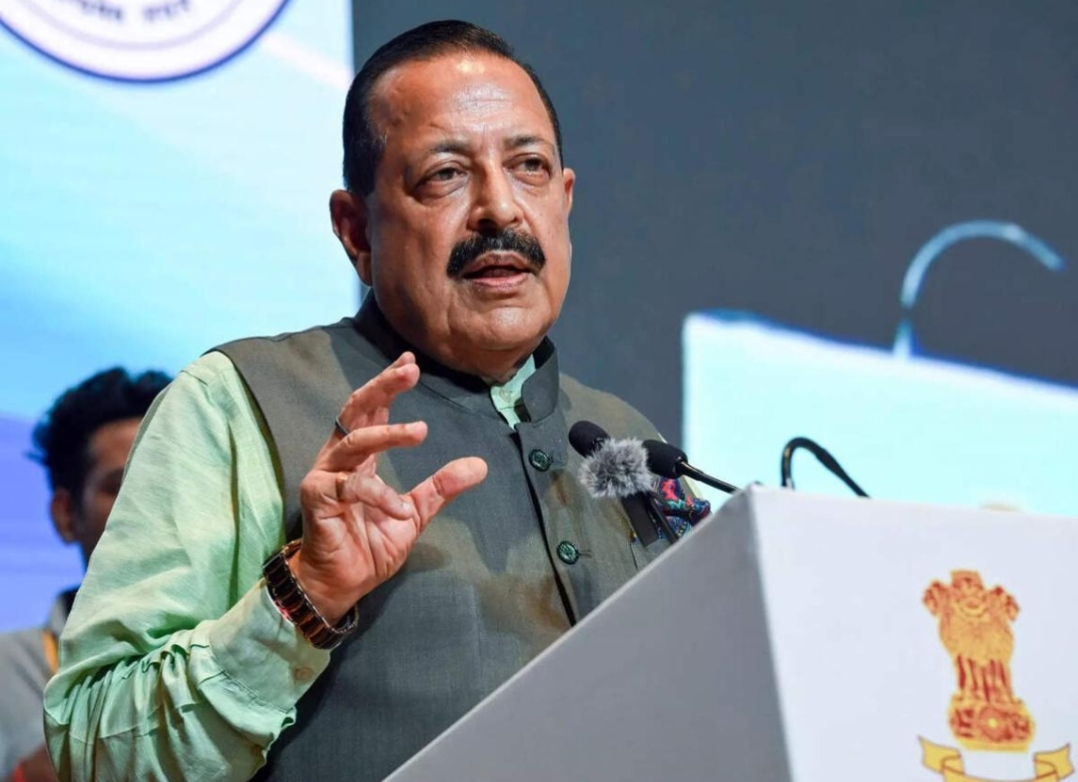
Jammu, June 5: Union Minister for Science and Technology and Earth Sciences, Jitendra Singh, on Thursday inaugurated India’s seventh Regional Meteorological Centre (RMC) in Jammu, marking a significant step towards strengthening weather forecasting and disaster management services in the Himalayan region.
The newly established centre will cater to the weather forecasting needs of Jammu and Kashmir, Ladakh, and Himachal Pradesh, providing specialised meteorological services, climate support, and early warning systems tailored to the unique geographical challenges of the region.
Speaking at the inauguration ceremony, the Minister announced that another Regional Meteorological Centre would soon be set up in Lucknow, further expanding India’s regional weather forecasting network.
Jitendra Singh said the Jammu centre would enhance weather monitoring capabilities and provide district-wise forecasts, mountain weather updates, tourist advisories, city-specific weather services, and timely warnings for natural disasters such as flash floods, cloudbursts, avalanches, heavy snowfall, thunderstorms, and landslides.
The services are expected to benefit pilgrims undertaking the annual Amarnath and Vaishno Devi yatras, farmers, transport operators, hydropower projects, disaster management agencies, and security forces operating in challenging terrain.
Highlighting the progress made over the past decade, the Minister noted that Jammu and Kashmir had no Doppler Weather Radar in 2014, whereas four such radars are now operational at Jammu, Srinagar, Leh, and Banihal Top. Under Mission Mausam, five additional Doppler Weather Radars have been proposed for Anantnag, Rajouri, Baramulla, Kishtwar, and Doda districts.
The region’s weather observation network has also expanded considerably. At present, Jammu and Kashmir and Ladakh have 56 observatories, including 15 manual observatories, 25 Automatic Weather Stations (AWSs), and 16 Automatic Rain Gauges (ARGs). In comparison, only 13 AWSs and 14 ARGs were operational in 2014.
Recently, Automatic Weather Stations have been installed at Kargil, Ukhral in Ramban district, and Mata Vaishno Devi Bhawan. During the current financial year, nearly eight additional AWSs and five ARGs are expected to be commissioned. The number of stations under the Daily Rainfall Monitoring Scheme has increased from 30 in 2014 to 85 at present, significantly improving rainfall monitoring and forecasting capabilities.
The Minister said the establishment of RMC Jammu marks a major restructuring of the India Meteorological Department regional operations. Previously, the Regional Meteorological Centre in Delhi coordinated weather services for Jammu and Kashmir, Ladakh, Himachal Pradesh, Uttarakhand, Punjab, Haryana, Uttar Pradesh, and Rajasthan. With the new arrangement, weather services for Jammu and Kashmir, Ladakh, and Himachal Pradesh will be managed from Jammu, while the proposed Lucknow centre will cater to Uttar Pradesh and Uttarakhand.
Jitendra Singh also highlighted several scientific initiatives undertaken in the region. The Meteorological Centre Srinagar has signed collaborative agreements with Sher-e-Kashmir University of Agricultural Sciences and Technology Jammu, Sher-e-Kashmir University of Agricultural Sciences and Technology Kashmir, and Islamic University of Science and Technology to strengthen research and capacity building in weather and climate sciences.
He further referred to the High-Altitude Cloud Physics Laboratory established at Patnitop in collaboration with Swiss scientific institutions for advanced studies on clouds and aerosols in the Himalayan ecosystem.
On earthquake monitoring, the Minister stated that the Jammu and Kashmir seismological network has undergone extensive modernisation. Existing seismic stations have been upgraded to digital systems, while an additional observatory has been established in Udhampur. A new seismological observatory has also been proposed for Kishtwar district.
Currently, five seismic stations are operational across Jammu and Kashmir and Ladakh, transmitting near real-time data to the National Centre for Seismology.
Announcing further measures, Jitendra Singh said an Automatic Weather Station and a seismology centre would be established in Kishtwar in the aftermath of last year’s disaster in the district. He also noted that the Srinagar Meteorological Observatory, which has been functioning for more than a century, has been recognised by the World Meteorological Organization as a Centennial Observing Station.
“Now there will be regional forecasts, district-wise forecasts, separate forecasts for tourists, and dedicated mountain forecasts,” the Minister said, adding that customised forecasting services would better address the specific requirements of the Himalayan region.
Emphasising the importance of weather services in disaster preparedness, he said timely forecasts of flash floods, cloudbursts, avalanches, heavy snowfall, thunderstorms, and landslides would significantly strengthen disaster response and public safety across the region.