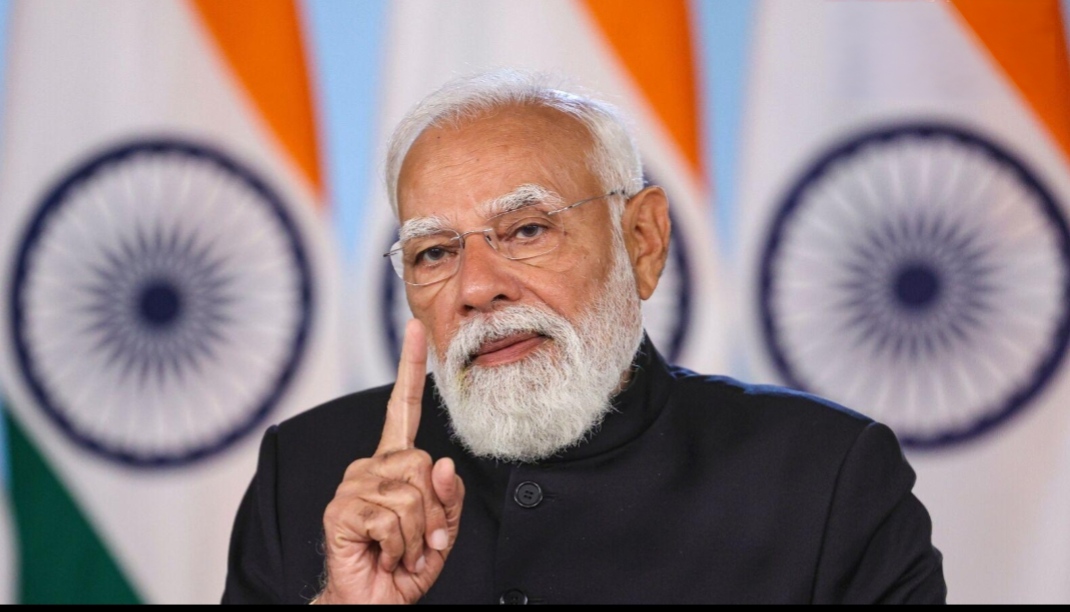


New Delhi, India, June 6: Prime Minister Narendra Modi on Saturday chaired a meeting of the Prime Minister’s Economic Advisory Council (EAC-PM), where members deliberated on measures to sustain and accelerate India’s economic growth amid ongoing global geopolitical and economic challenges.
During the meeting, the Prime Minister and council members discussed a range of policy initiatives aimed at strengthening economic resilience, improving ease of living, and enhancing the ease of doing business in the country. The council also presented its assessment of the impact of the continuing West Asia conflict on India and the global economy.
The discussions come at a time when economies worldwide are facing heightened uncertainty due to geopolitical tensions, trade disruptions, and uneven growth patterns.
Last month, Prime Minister Modi appealed to citizens to contribute towards the country’s economic resilience by reducing dependence on imported fuel and embracing sustainable alternatives. He urged people to adopt work-from-home practices where feasible, minimise fuel consumption, prefer indigenous products, reduce unnecessary foreign travel, shift towards natural farming, moderate cooking oil usage, and curb excessive gold purchases.
Emphasising energy conservation, the Prime Minister encouraged greater use of public transportation, metro services, carpooling, railway freight movement, and electric vehicles to reduce dependence on petrol and diesel and mitigate the impact of global fuel price volatility.
Meanwhile, India’s economy continued to demonstrate strong momentum, outperforming market expectations in the fourth quarter of the financial year 2025-26. According to official data released on June 5, the country’s real Gross Domestic Product (GDP) expanded by 7.8 per cent year-on-year during the January-March quarter, while full-year growth is estimated at 7.7 per cent.
Real GDP at constant prices reached Rs 87.77 lakh crore in the fourth quarter, compared to Rs 81.40 lakh crore during the same period of the previous fiscal year. Nominal GDP for the quarter stood at Rs 94.65 lakh crore, registering a growth of 9.1 per cent.
For the full financial year 2025-26, real GDP is estimated at Rs 323.12 lakh crore, up from Rs 299.89 lakh crore in FY25. Nominal GDP is projected at Rs 346.36 lakh crore, reflecting an annual growth rate of 8.9 per cent.
Gross Value Added (GVA), a key indicator of economic activity, is estimated to have grown by 7.9 per cent during FY26, while nominal GVA increased by 9.1 per cent. In the fourth quarter alone, real GVA rose by 7.9 per cent and nominal GVA by 9.9 per cent.
The latest data indicate that the secondary and tertiary sectors remained the primary drivers of economic expansion. The secondary sector is estimated to have grown by 8.8 per cent during FY26, while the tertiary sector expanded by 9.3 per cent. The primary sector recorded a growth rate of 3.2 per cent, supported largely by agriculture and fisheries.
The strong growth figures underscore India’s resilience amid global economic headwinds and reinforce the government’s focus on sustaining high growth through structural reforms and domestic economic strengthening.