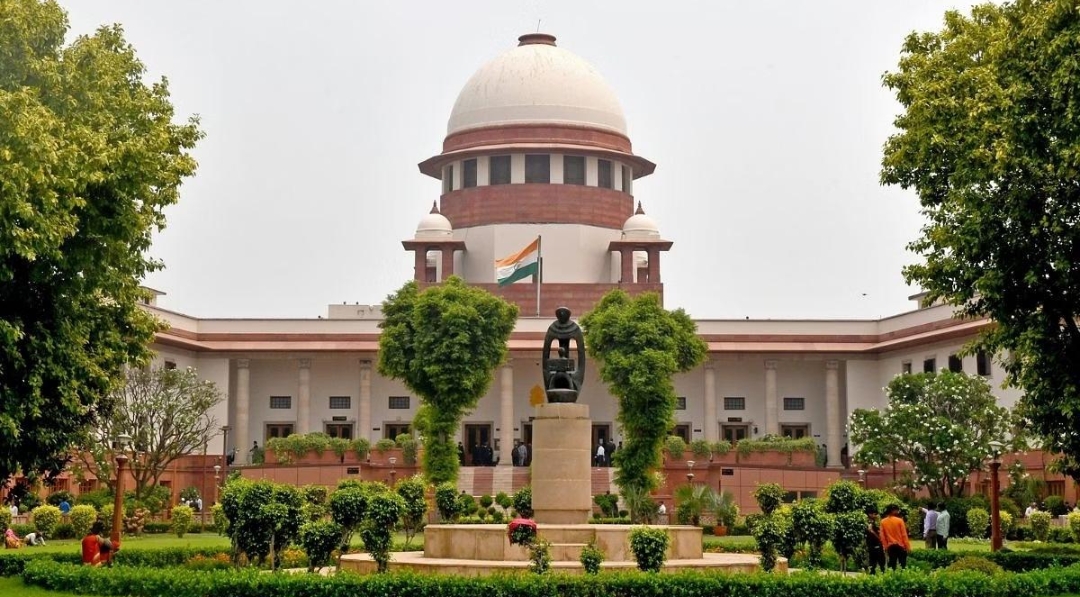


New Delhi, September 16: A public interest litigation (PIL) has been filed in the Supreme Court challenging the Union Finance Ministry’s September 14 Gazette notification and the September 15 Merchant Discount Rate (MDR) framework allowing charges on Person-to-Merchant (P2M) UPI transactions above Rs 2,000.
The petition, filed by advocate Anjan Datta, also challenges the constitutional validity of the amended Section 10A of the Payment and Settlement Systems Act, 2007. The Union government, Reserve Bank of India (RBI), National Payments Corporation of India (NPCI) and the UPI and Services Steering Committee have been named as respondents.
The petitioner has argued that the amended Section 10A gives the executive discretion to determine which electronic payment modes would remain protected from charges and the transaction values to which such protection would apply. According to the plea, Parliament has not specified a policy, formula, ceiling or safeguards governing the exercise of this power.
The petition contends that the provision amounts to excessive delegation of essential legislative functions, as it does not set criteria for the selection or exclusion of payment modes, transaction-value classifications, merchant categories or withdrawal of the no-charge protection.
The petitioner has also questioned the manner in which the MDR rates were introduced. The plea states that the September 14 notification did not prescribe specific MDR rates and that the detailed rates, caps and sectoral classifications were subsequently announced through a Finance Ministry press release following deliberations by the UPI Steering Committee.
According to the petition, a levy of general application affecting merchants cannot be introduced through a press release alone and requires a duly authorised statutory instrument published in the Official Gazette. The petitioner has alleged that no corresponding notification, rule or order prescribing the rates was published.
The plea further challenges the framework under Article 14 of the Constitution, citing differential treatment between UPI and RuPay debit-card transactions. It states that UPI transactions remain protected from charges only up to Rs 2,000, while RuPay debit-card payments continue to have no-charge protection without a monetary ceiling.
The petitioner has also questioned the Rs 2,000 transaction threshold and the Rs 1 lakh monthly receipt threshold for small merchants. The plea describes these as classifications for which no empirical basis has been disclosed. It argues that a transaction of Rs 2,001 would be treated differently from one of Rs 2,000 and that a merchant could lose the protection after crossing the monthly receipt threshold.
The petition also raises a challenge under Article 19(1)(g), arguing that MDR would affect merchants’ receipts and their ability to carry on trade and business. It states that no impact assessment or justification has been disclosed to establish that the rates are necessary for funding cybersecurity and digital-payment infrastructure.
The petitioner has also raised concerns about the possible economic impact on consumers. The plea argues that a direction preventing merchants from directly passing MDR on to customers would not prevent other consequences, including changes in prices, withdrawal of discounts, refusal to accept UPI payments, minimum transaction requirements or split payments.
The petition alleges that the framework was introduced without disclosure of a public consultation paper, draft rates, merchant impact study or responses from stakeholders. It seeks disclosure of the committee’s minutes, cost study, impact assessment, stakeholder submissions, rate methodology and distribution formula.
Another ground of challenge concerns the manner in which the amendment to Section 10A was enacted. The petitioner argues that the amendment was included in the Taxation and Other Laws (Amendment) Act, 2026, which was passed as a Money Bill, although the provision concerns regulation of charges between banks, payment-system providers and merchants. The plea contends that the subject does not fall within the matters specified under Article 110 of the Constitution.
The petitioner has sought a declaration that the amended Section 10A is unconstitutional and void and has consequently sought quashing of the September 14 Gazette notification and September 15 MDR framework.
In the alternative, the plea seeks that the provision be read down so that it does not permit withdrawal of no-charge protection based on transaction value or merchant classification, or allow prescription and distribution of MDR without legislative criteria and authority.
The petition also seeks directions requiring the respondents to place on record the authenticated notification, statutory authority, constitution of the committee, its agenda and minutes, cost study, impact assessment, stakeholder inputs, rate methodology, distribution formula, RBI approval and enforcement safeguards.
The petitioner has further sought a declaration that no MDR or similar compulsory charge can be imposed solely through a press release or FAQs without a duly authorised and published statutory instrument. Alternatively, the plea seeks reconsideration of the framework through a process involving public consultation, merchant and consumer representation, empirical data, safeguards for micro and small enterprises, independent audit and periodic review.
The petition also seeks an enforceable mechanism to prevent the passing on of MDR to consumers, including disclosure of charges, complaint and audit mechanisms, penalties for undisclosed fees and restitution for unlawful collections.