By Varinder Singh | Bureau Chief, Washington, D.C. | CNC NEWS
November 27, 2026: The controversy surrounding former Delhi Chief Minister Arvind Kejriwal’s official residence, known by the BJP's nickname 'Sheesh Mahal' (शीश महल), has renewed questions about public expenditure, political transparency and taxpayers’ money.
The Aam Aadmi Party (AAP) emerged promising to fight corruption, challenge VIP privileges and empower ordinary citizens. The renovation of its former chief minister’s official residence raises a question that every democracy should take seriously: are elected leaders living up to their promises?
₹58.83 crore: Delhi government opens former CM residence to media
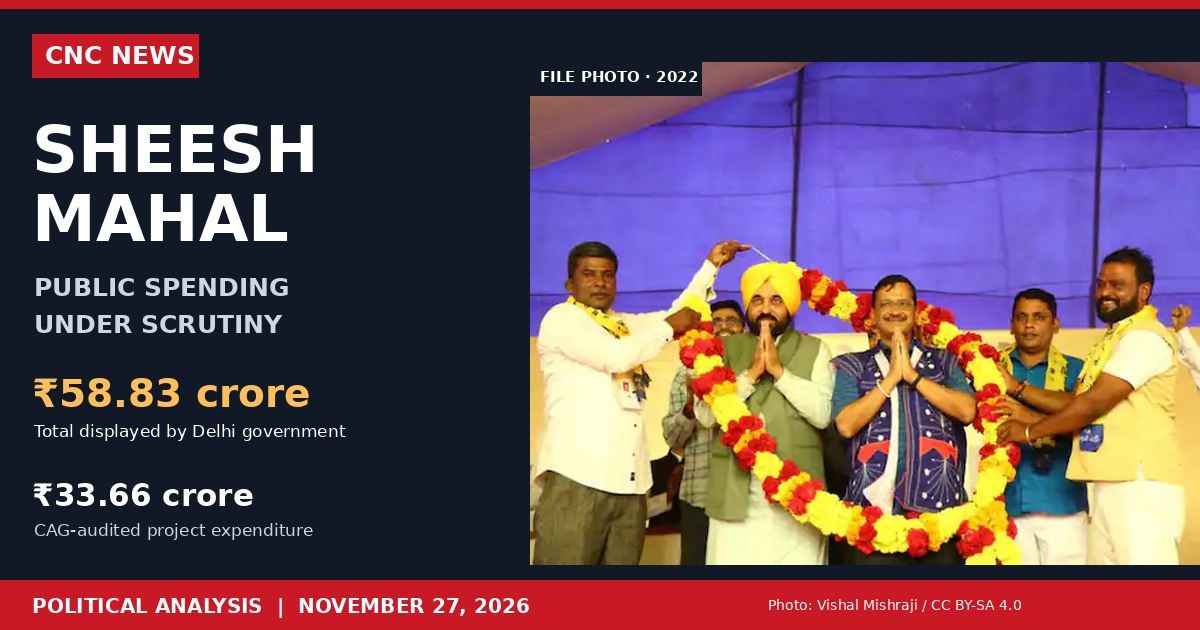
On November 27, the BJP-led Delhi government invited journalists inside 6, Flagstaff Road, to see the property and furnishings. Outside the property, officials displayed an expenditure total of ₹58,83,66,314. This government-displayed figure is distinct from the audited expenditure on the works examined by the Comptroller and Auditor General of India (CAG); the figures should not be added together or treated as identical measures.
How much was spent during COVID-19?
The project began in 2020 and was completed in 2022. The CAG report, tabled in the Delhi Assembly in March 2026, identified substantial cost increases and problems in the procurement and approval process.
| Expenditure details | Amount |
|---|---|
| Preliminary estimate, as reported by The Indian Express | ₹7.91 crore |
| Contract awarded cost, according to CAG | ₹8.62 crore |
| Final audited project expenditure | ₹33.66 crore |
| Higher-specification and ornamental items (included in the audited total) | ₹18.88 crore |
| Liabilities incurred without prior approval | ₹9.34 crore |
| Separate total displayed by Delhi government at the media tour | ₹58.83 crore |
The audit recorded issues in bidder selection, changes in specifications, repeated supplementary financial sanctions and funds diverted from other work. The awarded amount and final expenditure are confirmed in the CAG’s official audit summary.
During the pandemic, many families were dealing with hardship, loss of income and medical emergencies. For that reason, the timing and scale of the expenditure deserve especially close scrutiny. Government officials should explain why the work was necessary, how the contracts were approved, and whether the expenditure represented value for the public.
Inside the 'Sheesh Mahal'
Reports of the media tour describe expensive household furnishings and facilities, including chandeliers, sofas, curtains, a television unit and a jacuzzi. According to the price tags displayed by officials and reported by news outlets, examples include:
| Item | Reported price |
|---|---|
| Chandelier | ₹11.56 lakh |
| Central table | ₹6.79 lakh |
| Curtains | ₹5.69 lakh |
| Dining chairs | ₹5.58 lakh |
| Two-seat sofa | ₹5.47 lakh |
| Television unit | ₹30 lakh |
These prices are attributed to the display and media coverage; they are not findings of individual criminal liability. Readers can view photographs of the actual residence in The Indian Express’s coverage of the media tour.
Can the public visit for ₹20?
Delhi’s Public Works Department Minister Parvesh Verma announced plans for public tours following the media visit. Officials indicated that the ticket may cost approximately ₹20, with possible free entry for senior citizens and college students. The final booking arrangements and opening dates had not been confirmed at publication.
The founding promise: no VIP culture
AAP grew out of India’s anti-corruption movement in 2012 and celebrates November 26 as its foundation day. It entered politics with a message of honesty, ordinary citizens’ participation and an end to political privilege. Kejriwal served as Delhi chief minister from 2015 to 2024 during the period when he occupied the residence.
There is an important distinction between the promises made by a party and the choices made once it holds office. The controversy is a reminder that public expenditure should be judged against documented procurement records, the needs of citizens and the standards of accountability promised by elected representatives.
AAP’s response
AAP has rejected the allegations of overspending and characterised the BJP’s renewed focus on the property as an attempt to distract from other issues. It has stressed that the bungalow was a government residence, not Kejriwal’s private property. The Indian Express reported that the renovation followed a roof collapse in 2020 and a reported structural safety assessment. The BJP, by contrast, has portrayed the expenditure as evidence of extravagance. Audit concerns do not in themselves establish criminal guilt.
Accountability in Delhi and Punjab: an editorial call
As an Indian diaspora journalist, I believe citizens in India and overseas have a legitimate interest in transparent public finances. In my view, authorities should conduct a rigorous, impartial review of public expenditure and credible allegations involving AAP's ministers, MPs and MLAs in Delhi and Punjab over the past decade, with the same standard applied to politicians from all other parties. No one should be presumed guilty simply because of party membership.
- Examine government procurement, contracts and expenditure records.
- Verify asset declarations and investigate credible evidence of disproportionate wealth or misuse of public funds.
- Refer substantiated cases to the CBI, ED or competent vigilance authorities where their statutory jurisdiction permits.
- Protect the independence of investigations from political pressure and publish findings where lawful.
- Recover misappropriated public money and seek the penalties provided by law where wrongdoing is proven.
Even a small unlawful diversion of public money deserves investigation. India's elected officials, regardless of party or position, should be held to an equally high standard.
Should convicted corrupt politicians be barred from elections for life?
In my view, lawmakers should consider a lifetime prohibition on contesting elections for those convicted of serious corruption, subject to constitutional safeguards and judicial review. Such a prohibition would require appropriate legal reform; it is not an automatic penalty that can be imposed merely on the basis of allegations. Where criminal wrongdoing is established in court, an apology should never replace lawful punishment, which may include imprisonment, financial penalties and recovery of illicit assets.
Public money belongs to the people. Public office must be a public responsibility, not an opportunity for personal enrichment. No individual should be above the law.
Varinder Singh
Bureau Chief – Washington, D.C.
CNC NEWS | Cross Nation Chronical
Sources and further reading
- Comptroller and Auditor General of India — official audit report and summary
- The Indian Express — November 27 media tour and AAP response
- The Times of India — proposed public tours and displayed furnishings
- Moneycontrol — displayed expenditure and item prices
- The New Indian Express — March 2026 audit coverage
- AAP — official party history and foundation-day statement
- Featured graphic includes the 2022 archival photograph Arvind kejariwal.webp by Vishal Mishraji, licensed under CC BY-SA 4.0. Photo resized and incorporated into a CNC News graphic, shared under the same license; it does not depict the residence.
