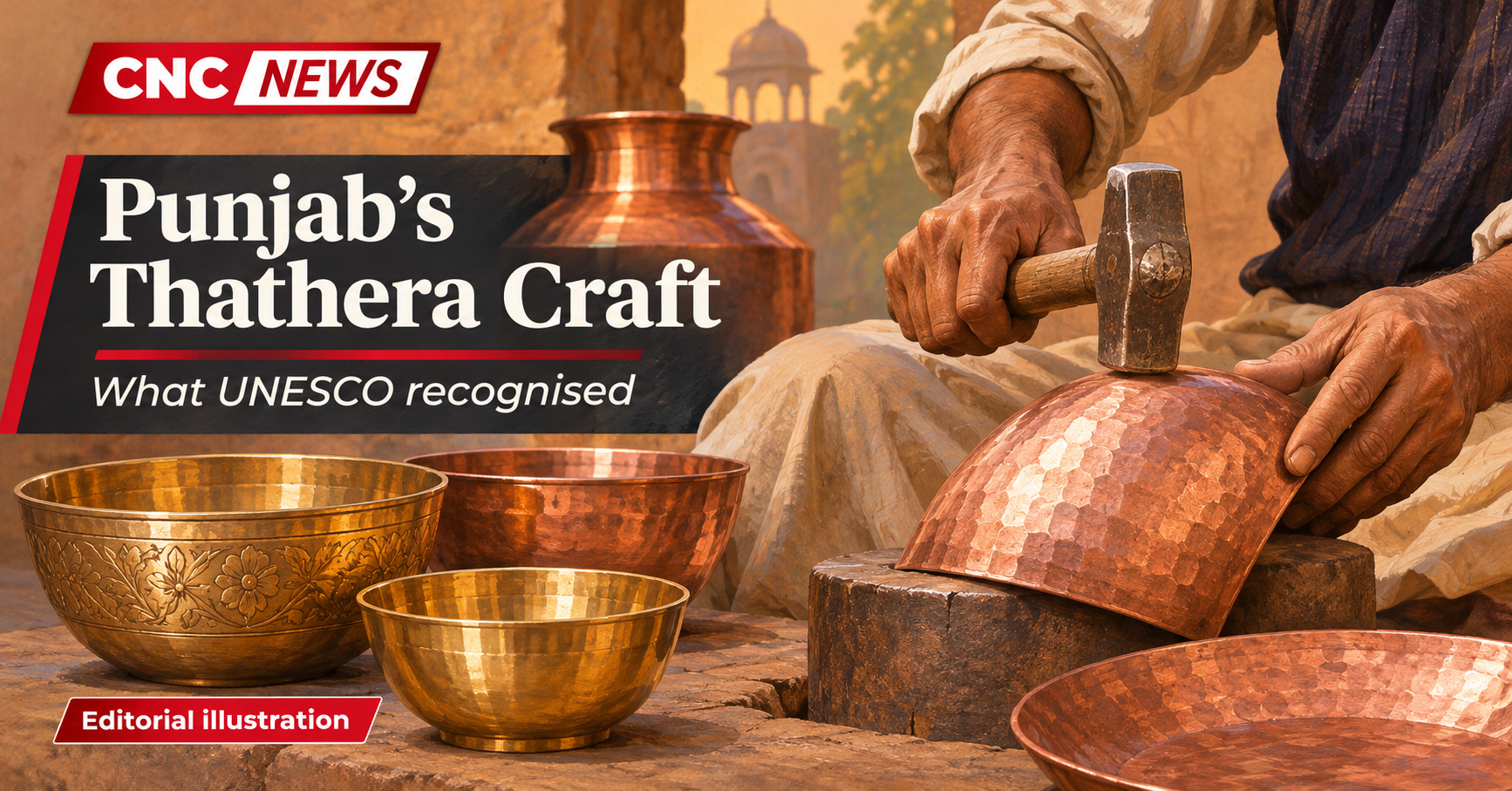
The Thatheras of Jandiala Guru received UNESCO recognition for the knowledge and skills behind their traditional brass and copper utensils—and for the community life that sustains those skills. Inscribed in 2014 on UNESCO’s Representative List of the Intangible Cultural Heritage of Humanity, the craft illustrates how everyday objects can carry generations of cultural knowledge. This is an explanation of an established recognition, not a new announcement. UNESCO’s inscription record.
For readers in Punjab and overseas, the central question is straightforward: what makes the making of a bowl or cooking vessel a matter of cultural heritage? The answer involves skilled labour, family learning and the relationship between a community and its work.
What exactly did UNESCO recognise?
The inscription covers the traditional brass and copper craft of utensil making among the Thatheras of Jandiala Guru in Punjab. It recognises a living practice associated with a particular community.
UNESCO’s explanation of traditional craftsmanship draws an important distinction: safeguarding focuses principally on the knowledge and skills used to make things. Keeping a finished vessel in a collection preserves an object; enabling another generation to learn its manufacture helps sustain the craft itself. Both can have value, but they serve different purposes. UNESCO’s traditional craftsmanship guidance.
The distinction also explains why heritage can be found in a working neighbourhood. It need not be confined to a monument, archaeological site or museum.
How are the utensils made?
UNESCO’s account describes metal being flattened into plates and hammered into curved forms. Artisans control heat while shaping the material, then finish the utensils by hand. Traditional polishing materials include sand and tamarind juice, while carefully placed hammer marks create decorative patterns.
The range includes bowls, plates, water and milk pots, and larger cooking vessels. These objects have practical and ceremonial uses, including individual and community occasions.
The same account describes the manufacturing knowledge as being passed orally from father to son. It also connects metalworking with family relationships, working practices and social identity. The inscription therefore concerns much more than the appearance of a finished pot.
A history carried through workshops
The Indira Gandhi National Centre for the Arts’ inventory identifies the craft settlement as Bazar Thatherian, in Gali Kashmrian at Jandiala Guru. Its description brings together the kiln, tools, fuel and specialised hammering techniques as parts of a wider knowledge system.
The archived document also records migration between Gujranwala, now in Pakistan, and Jandiala Guru: artisan families came from Gujranwala while Muslim craftspeople moved in the other direction. This gives the craft a cross-border historical dimension alongside its local identity.
That inventory is a historical record, not a current census. Its family-count figures should not be presented as the number of active artisans working today. Establishing today’s workforce, apprenticeships and workshop conditions would require fresh reporting. Read the archived IGNCA inventory.
Recognition is only one part of safeguarding
UNESCO’s 2014 committee decision identified the craft as a source of social and cultural identity. It also recorded participation by craftspeople, families, their manufacturers’ association and other organisations in the nomination process.
The decision referred to proposed safeguarding measures that included training, municipal water provision and restoration of traditional buildings combining workshops and homes. These were measures described in the nomination; the decision alone does not establish that every proposal was subsequently completed. Read the committee decision.
The practical implication is that preserving craftsmanship involves the conditions in which people work and learn. A heritage label can explain why a tradition matters, but assessing its present health requires evidence about whether knowledge is still being transmitted.
UNESCO’s broader guidance describes safeguarding as helping skills pass to future generations so that communities can continue producing crafts, expressing creativity and earning livelihoods.
Why this matters to the Punjabi diaspora
For families overseas, the story offers a useful way to explore Punjabi heritage through ordinary household objects. A family vessel can prompt questions about who made it, where it came from and how it was used.
Such a conversation should preserve uncertainty as well as memory. An inherited brass bowl cannot be attributed to Jandiala Guru solely because of its material or appearance. A maker’s name, purchase record or clearly attributed family account provides stronger provenance.
For community groups considering a heritage display, a useful approach would be to pair objects with explanations of the work behind them. Where artisans contribute demonstrations or interviews, organisers could agree payment, credit and permission for recordings in advance.
These are suggested approaches, not claims about an existing CNC programme. They reflect UNESCO’s emphasis on heritage being recognised and maintained by the communities that practise it. UNESCO’s explanation of intangible cultural heritage.
Understanding the recognition accurately
The clearest way to describe the Thathera inscription is as recognition of a community’s living craft tradition. It should not be treated as a certification of every copper or brass product offered for sale.
For readers exploring Punjab’s cultural inheritance, the story shifts attention towards the maker: the judgement needed to work the metal, the learning behind that judgement and the opportunity to pass it on. Those are the elements that make the workshop, as well as the finished vessel, part of the heritage story.
Explore more CNC coverage: Culture and heritage and Punjab news.