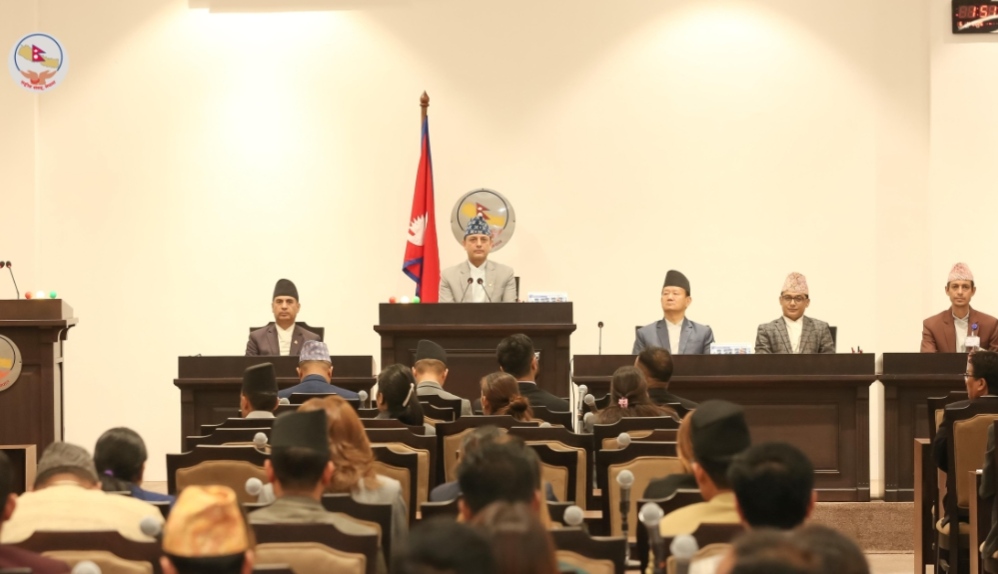


Kathmandu, Nepal, June 1: Proceedings in both houses of Nepal’s Parliament were disrupted on Monday after lawmakers staged protests against recent remarks made by Prime Minister Balendra Shah concerning border-related issues with India.
Members of both the House of Representatives and the National Assembly demanded that the Prime Minister withdraw his statement, apologise, and have the remarks expunged from the official parliamentary record. Opposition parties continued their obstruction of parliamentary proceedings, insisting that Shah provide evidence to support his claims.
Speaking in the House of Representatives, Rastriya Prajatantra Party lawmaker Gyan Bahadur Shahi said statements made by a Prime Minister carry significant national and international implications and must be grounded in facts.“When a Prime Minister makes any statement, it is perceived as the official position of the country. Such remarks should be based on facts, evidence, and reality rather than assumptions or emotions,” Shahi said, urging the Speaker to remove the controversial comments from the parliamentary record.
The controversy also reverberated in the National Assembly, where lawmakers questioned the basis of Shah’s statement. National Assembly member Ranjit Karna called on the government to provide evidence within 24 hours regarding the Prime Minister’s claims related to land use along the Nepal-India border.“If the Prime Minister is unable to substantiate his remarks, he should apologise to the people. An investigation committee should also be formed to determine how such a statement was made,” Karna said.
Several other lawmakers, including Rajendra Lakshmi Gaire, Ram Kumari Jhakri, and Tula Prasad Bishwakarma, demanded an official clarification from the government. The protests effectively halted proceedings in the upper house as members stood in opposition to the Prime Minister’s remarks.
The dispute stems from comments made by Prime Minister Shah on Sunday regarding border issues between Nepal and India. The remarks triggered immediate criticism from opposition lawmakers, who described the claims as baseless and sought supporting evidence.
In response to the growing controversy, Nepal’s Ministry of Foreign Affairs issued a clarification. Foreign Ministry spokesperson Lok Bahadur Paudel Kshetri stated that the Prime Minister’s comments referred to matters concerning boundary pillars, no-man’s land (Dashgaja), and cross-border land usage.
According to the ministry, technical studies have identified areas where land currently being used by Nepal may technically fall within Indian territory, and vice versa. The government reiterated its commitment to resolving all outstanding boundary issues through diplomatic dialogue based on historical treaties, maps, and bilateral agreements.
The issue comes amid renewed discussions over Nepal-India border matters. Last month, India’s Ministry of External Affairs responded to remarks made by Nepal regarding the border issue in the context of the Kailash Mansarovar Yatra.
MEA spokesperson Randhir Jaiswal stated that Lipulekh Pass has served as a traditional route for the pilgrimage since 1954 and that the yatra through the pass has continued for decades. He also reiterated India’s position that certain territorial claims made by Nepal are not supported by historical facts or evidence.
“Such unilateral artificial enlargement of territorial claims is untenable,” Jaiswal said, while reaffirming India’s willingness to engage in constructive dialogue with Nepal to address all outstanding bilateral issues, including boundary disputes, through diplomatic channels.